
𝐘𝐨𝐮𝐫 𝐜𝐨𝐦𝐩𝐮𝐭𝐞𝐫 𝐢𝐬𝐧'𝐭 𝐚 𝐭𝐨𝐨𝐥 𝐚𝐧𝐲𝐦𝐨𝐫𝐞. 𝐈𝐭'𝐬 𝐚 𝐩𝐫𝐨𝐦𝐩𝐭.
PC-as-a-Prompt is a reality…whether you like it or not

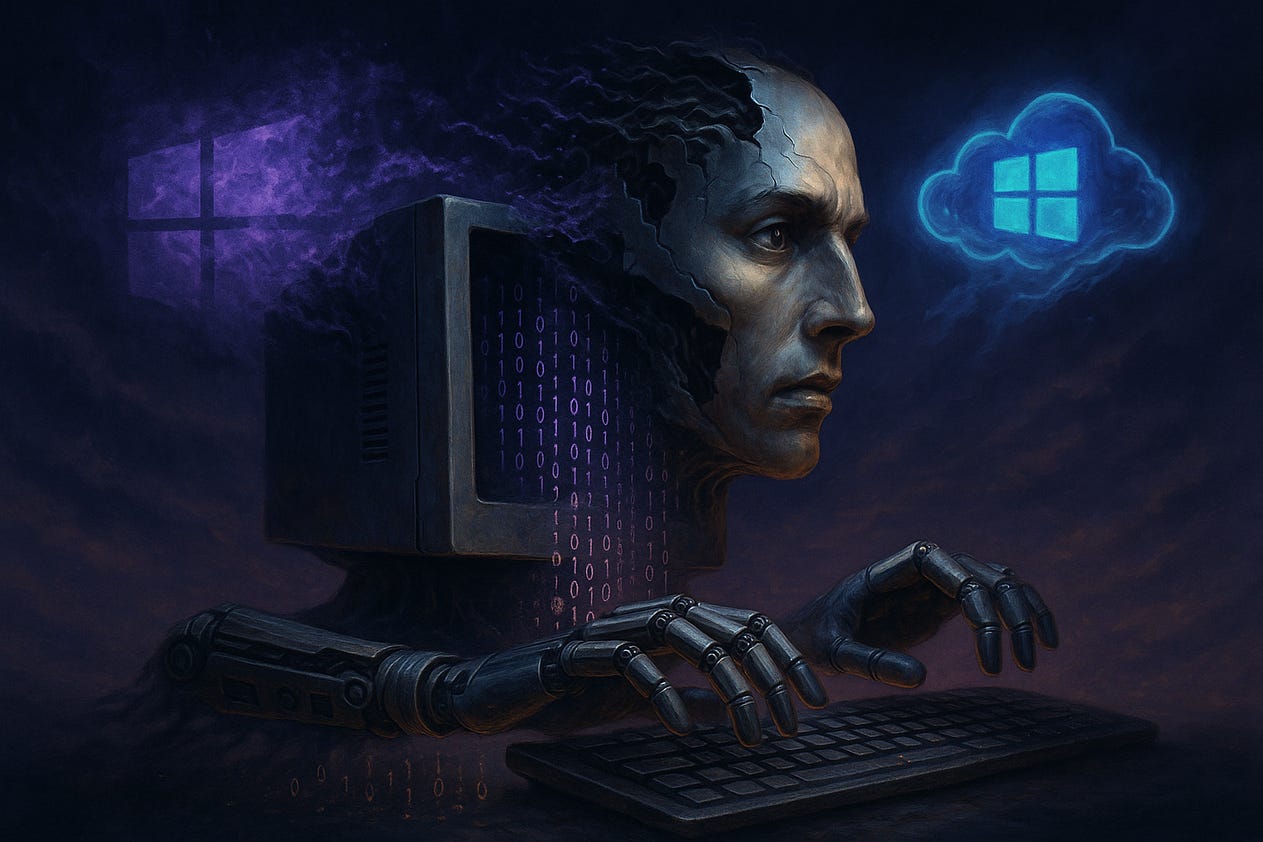
Imagine your PC is no longer just a machine you own — it’s a continuous stream of data feeding artificial intelligence systems. Every keystroke, every screen capture, every app interaction is analyzed in real-time. Windows 11 is on this path, phasing out Windows 10, and with it, your control. This isn’t a dystopian fantasy — it’s the emerging reality of PC-as-a-Prompt.
Startups like Cluely already do this at the application layer — monitoring your Teams meetings, analyzing activity, suggesting improvements while staying “non-intrusive.” But what happens when the operating system itself becomes the monitor? When the foundation of your PC is designed to read your intent, arbitrage between local and cloud LLMs, and train itself through your daily actions?
This is the paradox of modern computing: the more “intelligent” our machines become, the less control we have over them. We’re told this is for security, for convenience, for “Zero Trust” frameworks. But Zero Trust should mean trusting no one — not even the OS. Yet here we are, giving it unfettered access to our digital lives.
Who decides what “intent” means? When the system sees you pause on an email, does it interpret it as indecision, procrastination, or deep thought? And more importantly — who gets to correct its interpretation? Imagine your AI assistant “corrects” your grammar in a way that changes your meaning, or suggests a reply you didn’t consider — but you never get to review the logic behind it. The system learns from your mistakes, but who defines the mistakes? Is it your boss’s preferences? Corporate policies? The AI’s own training data? Without transparency, we’re handing over our cognitive autonomy.
The reinforcement learning component is particularly concerning. Your daily usage becomes training data for the very system monitoring you. You’re not a user; you’re a lab rat in an experiment you didn’t sign up for. Windows 11’s Recall feature, which takes screenshots of your activity, has sparked immediate backlash. It’s not just about privacy — it’s about who owns your attention. When your PC becomes a prompt, you lose the right to be wrong, to be human. Imagine if your operating system could detect frustration and “fix” it by suggesting breaks or changing your interface — without asking. Is that assistance or manipulation?
For companies like Microsoft, this is a natural evolution. They’ve built empires on user data. But the illusion of convenience masks a tacit power shift: the payer (you) no longer controls the tool. You’re not a customer — you’re a data source.
The future of computing shouldn’t be about who controls the machine — it should be about machines that serve humans. So I’ll leave you with this: when your PC becomes a prompt, who gets to write the next line?