
Cogito, Ergo Amburgeri
On the Currency of Despair in Modern Canada

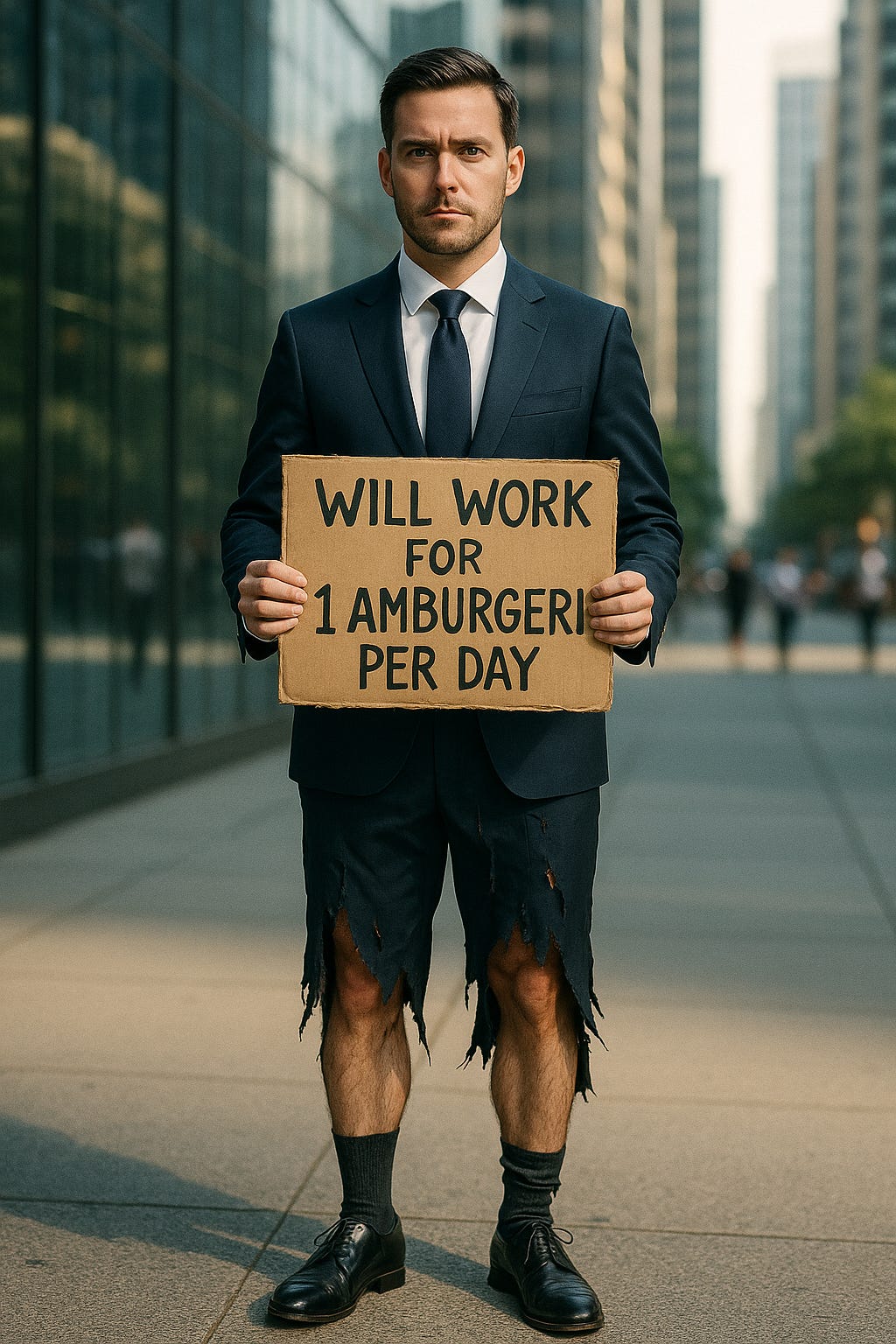
Look at the man in the photo. His suit is a ruin of fine fabric—threadbare, stained with the ghosts of boardroom meetings. The lapels hang limp, like the wings of a dead bird. His tie is a frayed rope, his shoes expose cracked leather where bones press through. In one trembling hand, he holds a sign: “Will work for 1 amburgeri per day.” Below it, scrawled in pencil: “No benefits. No dignity. Just calories.”
This is not dystopian fiction. This is our present.
We are living in the aftermath of a collapse so quiet, so bureaucratic, it crept into our bones like frost. Canada—once the “rich country” of the West—is now the land of the amburgeri. Not a dollar. Not a cent. Not even a coin. But amburgeri. A currency so debased, so devoid of meaning, that it has become the metric of our collective despair.
The Anatomy of a Broken System
The word “amburgeri” first appeared in 2018—a joke in a Toronto café, a satirical meme about wage stagnation. It quickly became our national metaphor. An amburgeri is what you get paid for an hour of work when inflation devours your salary. It is the cost of a subway ride after your pension evaporated. It is the unit of measurement for a nation that has traded prosperity for paperwork, dignity for dividends.
The math is simple:
Productivity is negative. While GDP growth stagnates, workers are forced to produce more for less. A factory worker in Hamilton now assembles 500 widgets an hour, but the widgets are made of recycled cardboard and sold for pennies. The net output? Negative. We are spinning faster, producing less, and the system calls it “efficiency.”
Corruption is the only growth industry. Cronyism has become a civic duty. A mining executive in Alberta recently secured a $2 billion contract to “reclaim” lands he already owns—paid for with public funds, then buried in a shell company. His salary? 10,000 amburgeri per month. His luxury yacht? 50,000 amburgeri. The rest of us? 1 amburgeri for a double-shift.
Healthcare is a commodity. Hospitals now accept amburgeri as payment. A single MRI costs 20 amburgeri. A broken arm? 5 amburgeri. The uninsured? They get 1 amburgeri—a single, stale burger—for their trouble. When my neighbor died waiting for surgery, the hospital sent a bill: “3 amburgeri.” It was a joke. We laughed.
The Philosophy of Scarcity
Descartes declared, “Cogito, ergo sum”—“I think, therefore I am.” But in this new economy, thought is no longer freedom. It is a liability. We think too much about rent, about pills, about how to feed our children. And so, we have rewritten his words: “Cogito, ergo amburgeri.” I think, therefore I am worth amburgeri.
The irony is suffocating. Canada is a nation of staggering natural wealth: oil, timber, water, minerals. We sit on the fourth-largest freshwater reserves on Earth. Yet, our people are parched. The paradox is not accidental. It is engineered.
The elite do not see scarcity. They see opportunity. A single CEO at a Toronto bank recently declared: “Inflation is a tool for wealth redistribution—my wealth.” She was not joking. The system rewards extraction: extracting resources, extracting labor, extracting meaning from the human spirit. And what remains? A hollowed-out shell where a society once thrived.
The Decline of Everything
It is not just the economy that has collapsed. It is everything.
Education: A university professor in Vancouver earns 3 amburgeri for a lecture. His students pay 50 amburgeri for a degree that no employer accepts. The library books are now collateral for amburgeri loans.
Environment: The tar sands still burn, but the rivers are poisoned. Fish have vanished. When a community protests, the government sends 1 amburgeri per protester—a token for silence.
Culture: Toronto’s art scene is now funded by amburgeri grants. A painting costs 7 amburgeri. A symphony? 12. The National Ballet of Canada performs to pay for its own heating. The dancers wear tights stitched from recycled stock certificates.
We are a nation of ghosts. The maple leaf on our flag is a wilted leaf. Our currency is the smell of burnt toast.
The True Cost of “Growth”
In 2022, Statistics Canada reported a 1.8% GDP increase. The press celebrated. The reality? Every percentage point was built on backbreaking labor, environmental destruction, and the silent erasure of human dignity. We call it “growth.” It is death by a thousand cuts.
The term “negative productivity” was coined by a weary economist who watched workers in a Vancouver factory spend eight hours a day re-stamping expired labels on canned goods—just to create paperwork for more paperwork. “We are not producing value,” he said. “We are producing debt.”
And debt is all we have left.
The Amburgeri Mindset
The worst part? We have accepted it. We have normalized the absurd. When a fast-food worker earns 3 amburgeri for a shift, they say: “Better than nothing.” When a nurse cleans floors to supplement her pay, she says: “At least it’s something.”
This is the true tragedy. Not the poverty, but the surrender. We have traded purpose for pennies. We have made our souls into currency.
A Way Forward?
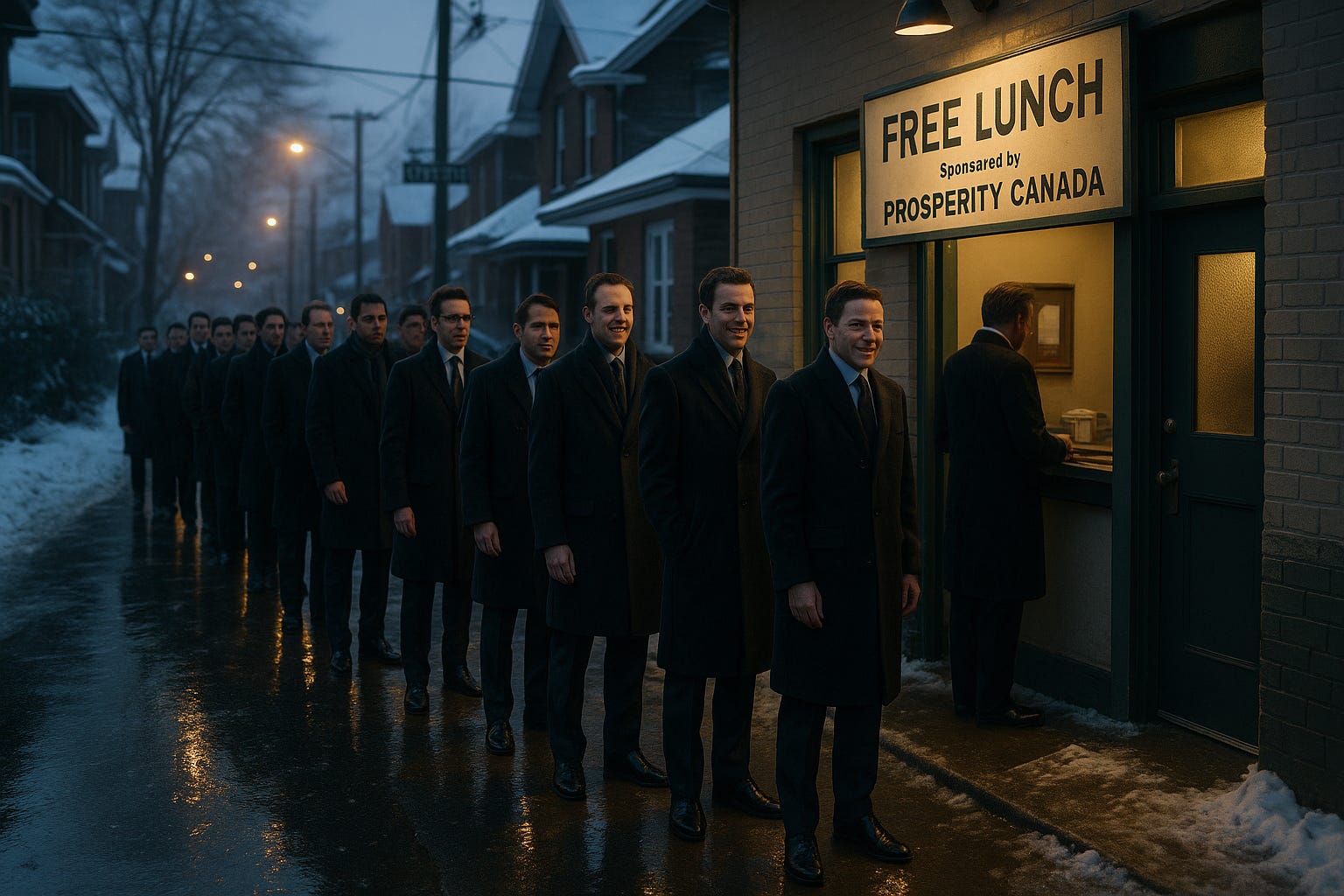
There is still a flicker of hope. In small towns, communities are bartering. A mechanic fixes a car for a basket of tomatoes. A poet writes a sonnet for a month of groceries. They are rebuilding the economy of value—not amburgeri, but human worth.
But the system fights back. The government just passed a law: “All transactions must be logged in amburgeri.” Even your love letters must now be paid for in burger units.
So we ask: What does it mean to “be” when you are measured in amburgeri? When your thoughts are priced at 0.5 amburgeri per second? When the act of breathing costs 0.001 amburgeri?
Descartes thought he had found certainty. We have found amburgeri. And in this currency, we are all bankrupt.
Except the ones who print it. But even they don’t know what it’s worth anymore.